Ray Tracing Monday, Again

I enjoyed the previous ray tracing monday two weeks ago, so let’s do it again.

Since it’s been two weeks, two resources:

  • “Real-Time Ray Tracing” – this is a free chapter (number 26) of Real-Time Rendering that we just finished and is free for download. 46 pages with a focus on DXR, but also including a detour through everyone’s favorite topic, spatial data structures for efficient ray tracing. Tomas, Angelo, and Seb did the heavy lifting on this one over the past 3 months, I helped edit and added bits where I could.
  • Ray Tracing Resources Page – along the way we ran across lots of resources. With the chapter finished as of today, I was inspired to make a page of links, mostly things I don’t want to lose track of myself or found of historical interest. Please do feel free to send me awesome resources to add, etc.

One entertaining thing I ran across was an image in the gallery for Chunky, a quite-good custom path tracer for Minecraft worlds:

Cornell blox

Cornell blox

CC0 – Public Domain for the World

Steve Hollasch mentioned that there’s a “new” (well, new to me – it’s 9 years old) Creative Commons instrument, CC0. Their website has an explanation of the problem with trying to put something you made into the public domain, and how CC0 solves this. Open Knowledge International (no, I never heard of them, either) recommends it, which I’ll take as a good sign. I didn’t know of this CC0 beast, and suspect readers here don’t, either, so now you do. It’s mostly not a license, it’s a “dedication,” a way to ensure that something you created is considered unowned and free to reuse in every country.

If you want to make sure your code is properly credited to you, use something such as the MIT license instead, or some other (often more restrictive) choice. Creative Commons recommends not using their other licenses for code, but rather some common source code license. I’m assuming (it’s not super-clear) that CC0 is also fine for code you’re putting into the public domain. Update: aha, Steve Hollasch sent this follow-up link – CC0 can be applied to code, and that link shows you how to do it.

Update: I received a number of interesting responses from my tweet of this post. David Williams points out that CC0 is approved by the Free Software Foundation for putting code in the public domain, as it has a fallback license for countries where public domain is not recognized. Arvid Gerstmann notes that dual-licensing with CC0 and the MIT license may be an even better option, for those companies where the lawyers haven’t approved the lesser-known CC0 but have approved use of code with the MIT license.

I know this all sounds like “it doesn’t matter, I’m never going to enforce this,” but it does, sadly. With Graphics Gems we made up a license long ago (basically, “don’t be a jerk”) because someone was trying to sell his company to a larger firm, which had some software testing firm test the smaller company’s code for copyright infringements, and various bits of Graphics Gems code popped up. If CC0 had existed, or maybe even the questionable (and rude) WTFPL, we would have gone with that. Happily, there is now the CC0. (tweet)

SIGGRAPH 2018 Stuff

First, the links you need:

  • Stephen Hill’s wonderful SIGGRAPH 2018 links page. Note the fair number of presentations recorded and quickly put up.
  • Material from the High Performance Graphics conference preceding SIGGRAPH is all online. Hats off to them for doing this.
  • Matt Pharr guest-edited a special section of the latest issue (vol. 37, no. 3, June 2018) of ACM TOG, full of papers on how production renderers work.
  • Bonus link: this GDC 2018 link collection by Krzysztof Narkowicz; also, GDC 2014 and earlier by Javier “Jare” Arevalo (thanks to Stephen Hill for the tip-off).

Beyond all the deep ray learning tracing, which I’ve noted in other tweets and posts, the one technology on the show floor that got “you should go check it out” buzz was the Looking Glass Kickstarter, a good-looking and semi-affordable (starting in the $600 range, not thousands or higher) “holographic” display. 60 FPS color, 4 and 8 megapixel versions, but those pixels are divided up among the 45 views that must be generated each frame. Still, it looked lovely, and vaguely magical (and has Sketchfab support).

I mostly went to courses and talked with people. Here are a few tidbits of general interest:

  • Shadertoy is one of my favorite websites, but it takes too long to load and looks like it’s locked up. I learned that you can avoid this problem! Sign in, go to your profile, Config, and check “Use previews (avoid compilation times)”. The site is so much more usable now. Too bad it’s not the default, I expect because they want to show you cool things without clicking, but then end up not showing anything for awhile, e.g., 22 seconds for the popular page to compile on my fast workstation. Now this page shows up immediately, and I don’t mind that the animations don’t run when my mouse hovers over the image. (thanks, David Hart!)
  • Colin Barré-Brisebois mentioned in NVIDIA’s real-time ray tracing course that Schlick’s Fresnel approximation could not be used in their work, but I didn’t quite catch why. The notes don’t mention this – I need to follow up with him… message sent. Aha, he replies, “It was because of total internal reflection. The Schlick approx doesn’t handle it.”
  • One of the speakers in Path Tracing in Production mentioned in passing that some film frames took 300 hours of compute per frame, 1600 rays per pixel. Aha, it was for “Transformers: The Last Knight.” I recall Jim Blinn had some rule-of-thumb long ago about how frames will take 20 minutes no matter how much faster computers get and algorithms improve efficiency. I think that amount needs updating, maybe based on cost (after all, the computers he was using for computation back then weren’t cheap).
  • The PDF notes for this course were extensive, though the course lectures were not recorded (heavens forbid anyone capture an unauthorized bunny or chimp). It’ll be interesting once consumer body cams become a thing. Anyway, the notes capture all sorts of bits of wisdom, such as ways of finding structure to help denoise images (yes, film rendering companies use denoising, too), e.g., “we used the tangent vector of the fur to provide the denoiser with “normals” as it proved to have higher contrast than either the true normals of the fur, or the normals of the skin that the fur was spawned from.”
  • You know quaternions. David Hart noted a different algebra, octonions, which I’d never heard of before. Bunch of videos on YouTube.
  • Regrets: I missed the “Future Artificial Intelligence and Deep Learning Tools for VFX” panel, and there’s no video AFAIK. I wanted to go, because after Glassner’s intro to deep learning course (which was recorded, and well-attended & well-received), Doug Roble from Digital Domain showed me a little bit of their markerless facial mocap system, which looked great. He writes, “We’ll probably have some YouTube videos… soon.”

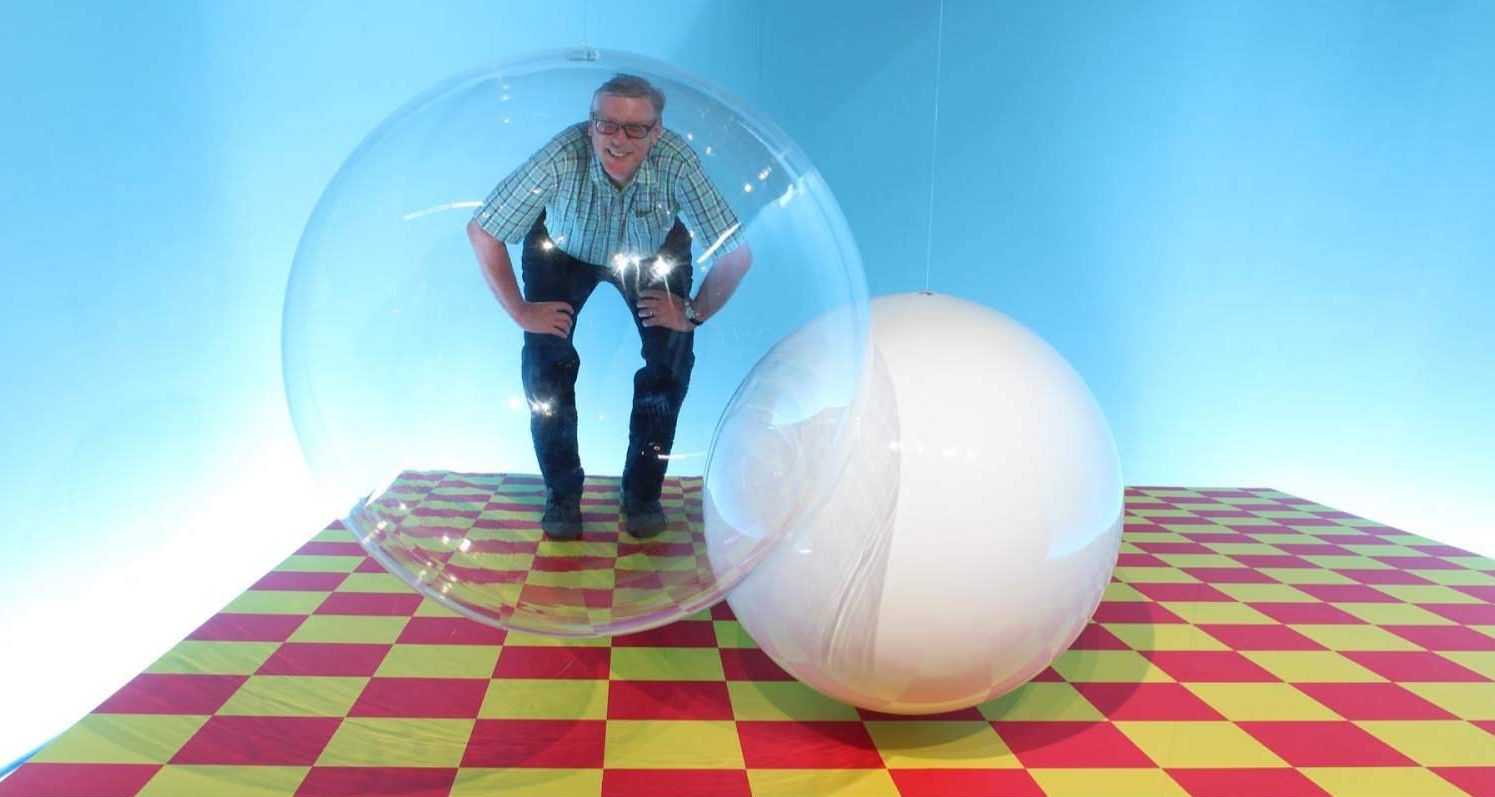
Finally, this, a clever photo booth at NVIDIA. The “glass” sphere looks rasterized, since it shows little refraction. Though, to make it solid, or even fill it with water, would have been massively heavy and unworkable. Sadly, gasses don’t have much of a refractive index, though maybe it’s as well – a chloroform-filled sphere might not be the safest thing. Anyway, it’s best as-is: people want to see their undistorted faces through the sphere. If you want realism, fix it in post.

Win a free copy of Real-Time Rendering, 4th Edition, and receive it someday…

Now that I’m back from SIGGRAPH, I can catch up on all the things. So here’s one: win a free copy of Real-Time Rendering, 4th Edition. Our publisher is giving away three copies, deadline to enter is August 31.

As far as actually receiving a copy of the book, well, if it’s any consolation, none of us authors have a physical copy at this point, either. Our publisher wrote on August 8th:

This reprint should be in the warehouse within the next 3 weeks.  I assume the fulfillment dept will give customer orders priority over author copies.

So it’s a case of the shoemaker’s children go barefoot. Amazon says the book’s back in stock on August 27th.

I do like that the first three chapters are free on Amazon, for Kindle, and Google Play, so I hope that will tide people over until these ship. That this much content was made free was unexpected, a happy decision on the publisher’s part. If you’re done with those chapters and still waiting, don’t forget to read Pete’s now-free books on ray tracing.

I got to see a physical copy of our book at SIGGRAPH, so know such things exist. I also bought the book on Kindle (which at first had some download problem on my iPhone and PC, but downloaded fine the next day) and Google Play (surprised to find it there; same price as Kindle, by some amazing coincidence), as I wanted to see if a layout problem in my local copy was present in the book (happily, it wasn’t – ahhh, the mysteries of LaTeX).

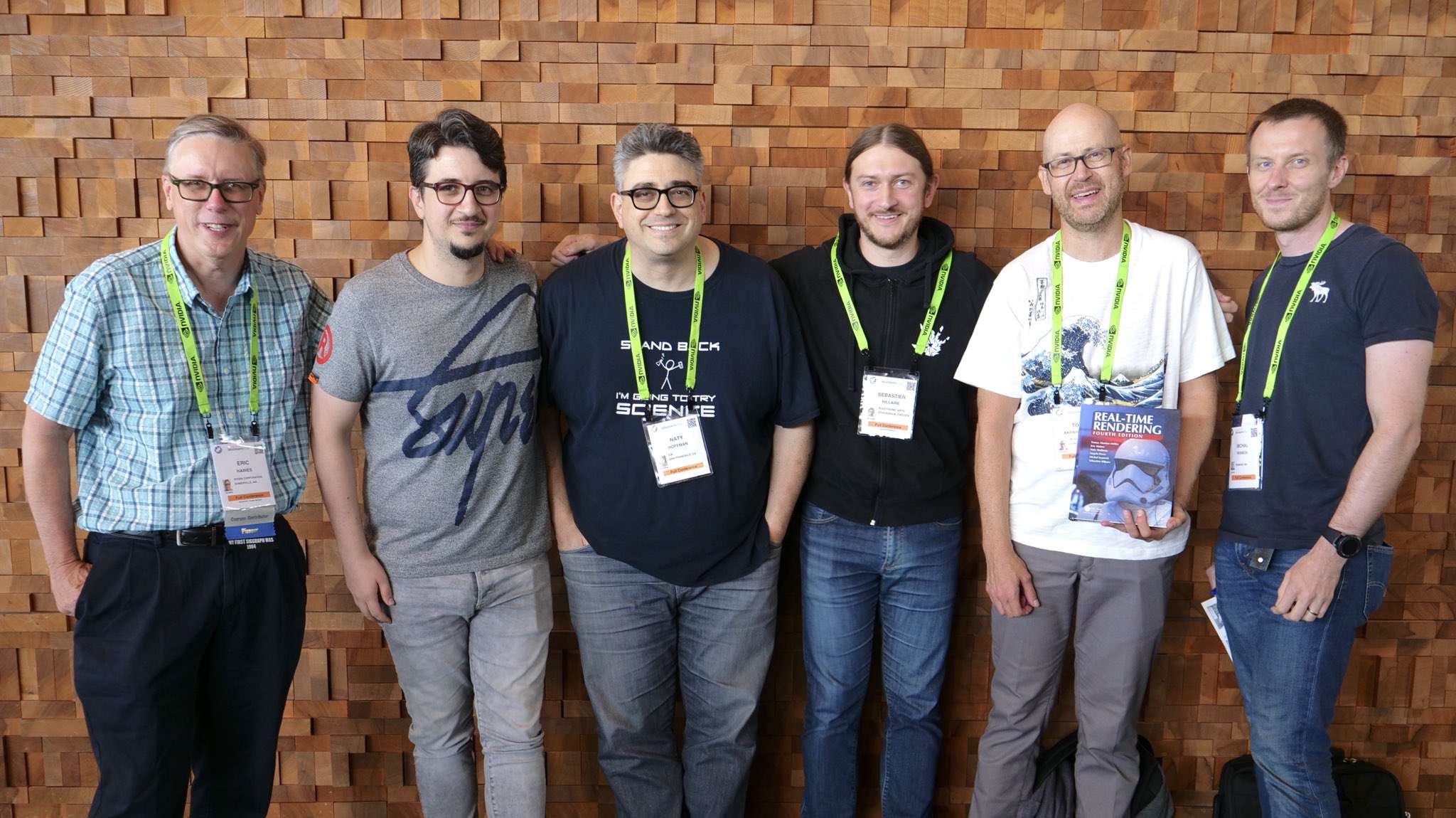
One of the best parts of SIGGRAPH was actually meeting my coauthors. The wild party on the yacht that night in Vancouver Harbor was really something, too, but then I realized I made that up.

Eric, Angelo, Naty, Seb, Tomas, and Michal; photo courtesy of Mauricio Vives

Ray Tracing Monday

OK, everything happened today, so I am believing the concept of time is no longer meaningful.

First, NVIDIA announced its consumer versions of their RTX ray tracing GPUs, which should come as a shock to no one after last week’s Ray Tracing Monday at SIGGRAPH. My favorite “show off the ray tracing” demo was for Battlefield V.

Then, this:

https://twitter.com/Peter_shirley/status/1029342221139509249

I love free. To get up to speed on ray tracing, go get the books here (just in case you can’t click on Pete’s link above), or here (our site, which shows related links, reviews, etc.). Then go to the SIGGRAPH DXR ray tracing course site – there’s even an implementation of the example that’s the cover of Pete’s first book.

Up to speed already? Start writing an article for Ray Tracing Gems. At SIGGRAPH we found that a few people thought they had missed the proposals deadline. There is no proposals deadline. The first real deadline is October 15th, for completed articles. We will judge submissions, and may reject some, but our goal is to try to work with any interested authors before then, to make sure they’re writing something we’ll accept. So, you can informally write and bounce ideas off of us. We avoided the “proposals” step in order to give people more time to write and submit their ideas, large and small.

BTW, as far as free goes, we’re aiming to make the e-book version of Ray Tracing Gems free, and also having the authors maintain reprint rights for their works.

All for now. Day’s not over yet.

65.16% of the Figures in RTR4 are Now Downloadable

You can now download 440.5 out of the 676 figures in the fourth edition. Go get them here. (the 0.5 is because there are five figures where we include only half the figure, because the other half was from someone else.)

There are also now links on the home resources page of figures where we took a snapshot from a live demo that runs in a browser. For example, the three listed here are a fun place to start.

RTR4 Book Signing at SIGGRAPH

We’ll be signing books at the ACM bookstore on Tuesday, August 14, from 12:30 to 1 PM. All six of us should be able to make it, and with any luck there will be books, too (go, printers, go!). Even if not, we have a back-up plan… Oh, and do note it’s the bookstore, which is usually tucked away somewhere and is not on the exhibit hall floor.

Anyway, we hope to see you there!

One Last Link – RTR4 Reference Page “Done”

I finally finished the Sisyphus-like task of putting useful links for RTR4’s references. For this brief moment I think all the links on that page work – enjoy it for the few minutes it lasts (and feel free to send me fixes, though I may blithely ignore these for a bit, as I’m sick to death of this task – no mas!). At the top of the page I note some pleasant tools, such as the Google Scholar search button extension, which saved me a lot of copying and pasting titles.

Oh, also, the free, online Collision Detection chapter now has its hyperlinked bibliography up, too, along with the appendices.

I’m writing a post mostly because I found this oddity: The classic paper

Torrance, K., and E. Sparrow, “Theory for Off-Specular Reflection from Roughened Surfaces,” Journal of the Optical Society of America, vol. 57, no. 9, pp. 1105-1114, Sept. 1967

is not one Google Scholar knows about in English. It turns up one in Japanese, which was a surprise. Searching on Google as a whole, it turns out Steve Westin still has one squirreled away. Paper archiving is a house of cards, I tells ya.

Next task: work on our main page of resources.

Less Movable Targets

Here’s an update to my previous blog post, on the volatility of web links.

The Twitter post has a bunch of responses, with some useful tidbits in there. Some resources mentioned: HTML5 UP! for free CC templates; gamedev.net has been around for almost 20 years and can act as an archive, gamedevs.org keeps some old presentations around. Go three paragraphs down for some web hosting suggestions. The idea of using the archive.org link as the “real” link is clever (and a bit sad), but assumes archive.org will always be around. Note that publishers such as the ACM allow you to put your published articles up on your homepage, your institution’s website, and on non-commercial repositories. I’m not sure how entities such as ResearchGate (where I’ve seen a number of papers stored) fit into this picture – they appear to be for-profit, e.g., they sell advertising, so I don’t think they fall into any of the ACM’s categories. I appreciate their efforts, but am concerned that papers there may go away because ResearchGate hasn’t been challenged by the ACM or others. Again, long-term durability is a question.

Also see the comments after the original post. My comment on “The sooner these are displaced by open publications like the JCGT, the better” is that, in graphics, there are no other free (to both readers and authors) journals, at least none that I know about. arXiv maybe qualifies. Looking there today, this article seemed like a handy summary, pointing to some resources I hadn’t known of before. But, trying to go to a site they mention in their article, Chrome warns, “Attackers might be trying to steal your information from dgtal.org” – OK, never mind. There might be great stuff at arXiv, but it seems like a firehose (10 articles published in graphics in the last week), without serious peer review. Editorial filtering and peer review is worth a lot. I guess you might be able to use a strategy of putting your preprint at arXiv, sort of like ResearchGate but less questionable (arXiv is run by Cornell). This approach is underutilized within graphics, AFAIK: only 2 papers on our refs page are available this way, vs. 25 for ResearchGate. If someone wants to explain what I’m missing here, great! Update: the ACM now permits authors to put preprints on ArXiv.

Thanks to you all for the followups, and I find my thoughts about the same: corporations come and go, more quickly than we expect. While I have a lot of faith in various institutions, ultimately I think the entity that best looks out for my interests is me. Having my own domain and website is good insurance against the vagaries from change of job status, change of corporate services (or existence), and change of webmaster. Me, I’m a cheapskate: http://erichaines.com is just a subdomain of realtimerendering.com, of which I’m the prime webmaster; we also host a number of other groups as subdomains, such as the Advances in Real-Time Rendering course notes repository and Ke-Sen’s invaluable work tracking conference articles – doing so costs me no time or money, as others maintain them. So another option is to share a domain and host among a bunch of people.

Yes, your own website costs a little money (the price of two cups of Starbucks per month), but admit it: you pay more in a month for your smartphone and internet service provider than the yearly cost for a website. It’s a bit of effort initially to register a domain and set up a website, but once the template and blog are in place, you’re done. Write a new article or slide set, one that took you hours or weeks to create? It’s five minutes to add it to your web page and upload it. Morgan McGuire, Andrew Glassner, and I like bluehost. Sven Bergström likes digitalocean for $5/month hosting, and gives some setup and admin tips. His previous favorite was site5. Sebastian Sylvan likes nearlyfreespeech, which I hadn’t heard of and looks quite cheap for a personal site (like, possibly something like $3.65 a year (plus $12 per Gig stored, or maybe less – the pricing is not clear), with a free Gig download a day), assuming you’re not serving up huge files or don’t get popular; ijprest notes in the comments that Amazon’s S3 hosting is bare bones, just basic hosting, but about as cheap at nearlyfreespeech and is pretty much guaranteed to outlast you.

Update Nov. 2019: A few more options, just in case. Google Domains and Namecheap are cheaper still for domain name registration, with Namecheap sounding a bit less expensive (but we’re talking a few dollars a year here, tops). For free hosting, Github is another interesting option. The advantages include collaboration and automatic backup of any changes, a la Git. We use this for I3D, for example, with the site’s elements visible to all. For non-programmer-types there are plenty of other options.

Oh, and the presentation from 2012 I mentioned in my last post that is no longer available – dead link – is now available again, as Duncan Fewkes sent me a copy and Michal Valient gave me permission to host it. It’s now here – a few minutes work on my part.

Question for the day: if Gmail and Google Docs suddenly went away, would this cause a collapse that would take us back to the 1990’s, 1950’s, or would the loss kick the world all the way back to some time in the 1800’s? Just a thought, you might want to use Google Takeout or other backup method now and then. If nothing else, visiting your Google Takeout site is interesting in that you see the mind-boggling number of databases Google has in your name.