Author Archives: Eric

7 Things for April 22

Quite the backlog, so let’s whip through some topics:

  • GDC: ancient news, I know, but here is a rundown from Vincent Scheib and a summary of trends from Mark DeLoura.
  • I like when people revisit various languages and see how fast they now are on newer hardware and more efficient implementations. Case in point: Quake 2 runs in a browser using javascript and WebGL.
  • Morgan McGuire pointed out this worthwhile article on stereoscopic graphics programming. Quick bits: frame tearing is very noticeable since it is visible to only one eye, vsync is important which may force lower-res rendering, making antialiasing all that much more important. UI elements on top look terribly 2D, and aim-point UI elements need to be given 3D depths. For their game MotorStorm, going 3D meant a lot more people liked using the first-person view, and this view with stereo helped perception of depth, obstacles, etc. There are also some intriguing ideas about using a single 2D image and reprojection using the depth buffer to get the second image (it mostly works…).
  • I happened to notice ShaderX 7 is now available on the Kindle. Looking further, quite a few other recent graphics books are. What’s odd is the differential in prices varies considerably: a Kindle ShaderX 7 is only $3.78 cheaper, while Fundamentals of Computer Graphics is $20 less.
  • Speaking of ShaderX, its successor GPU Pro is not out yet, but Wolfgang started a blog about it (really, just the Table of Contents), in addition to his other blog. The real news: you can use Amazon’s Look Inside feature to view the contents of the book right now!
  • Here are way too many multithreading resources.
  • In case you somehow missed it, you must see Pixels.

ACM SIGGRAPH 2010 Election

I received my ACM SIGGRAPH 2010 Election form today, it provides some login info and a PIN. SIGGRAPH members can vote for up to three people for the Director-At-Large positions.

I can be pretty apathetic about these sorts of elections, ACM and IEEE, I have to admit. Sometimes I’ll get inspired and read the statements, sometimes I’ll skim, sometimes I’ll just vote for names I know, sometimes I’ll ignore the whole thing. This year’s ACM SIGGRAPH election is different for me, because of issues brought up by the Ke-Sen Huang situation. Specifically, the ACM’s copyright policy is lagging behind the needs of its members.

For this SIGGRAPH election I was happy to see that James O’Brien is on the slate. In the past James has worked to retain the rights to his own images, so he’s aware of the issues. In his election statement he writes:

The ACM Digital Library has been a great success, but the move to digital publishing has created conflicts between ACM and member interests. ACM and SIGGRAPH are fundamentally member service organizations and I believe that through thoughtful and progressive copyright policies we can better align organization and member needs. Successful copyright policy has to work across formats, and SIGGRAPH is unique among ACM SIGs in that member-generated content spans a diverse range encompassing text, images, and video. Other organizations have embraced Open Access initiatives, but SIGGRAPH and ACM should be leading the way in this area.

He has my vote. He’s also the only candidate who addresses this area of concern, and in a thoughtful and professional manner. If you’re a SIGGRAPH member, I hope you’ll take the time this year to read over the statements, figure out your login ID and user number, and then go vote.

Thought for the Day

From here, no idea who made it; I’d like to shake his hand. Found here, but the poster found it via StumbleUpon.

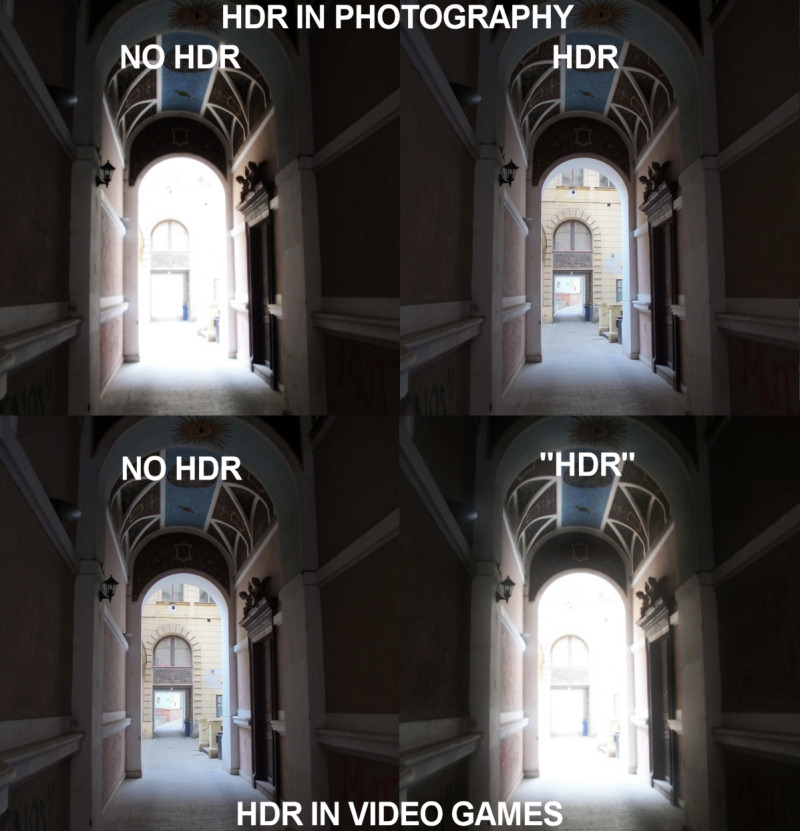
HDR in games

Having seen way too much bloom on the Atacama Desert map for the Russian pilots in Battlefield: Bad Company 2 (my current addiction, e.g. this and this), I can relate.

Edit: please do read the comments for why both pairs of images are wrong. I’m so used to HDR == tone mapping that I pretty much forgot the top pair is also technically incorrect (HDR is the range of the data, tone mapping can take such data and map it nicely to a displayable 8-bit image without banding) – thank you, Jaakko.

Best Book Title Ever, Period

I’ll get back to actual informational posts realsoonnow when I have some time, but I had to put this up immediately.

Amazon sent this one on to me, a book recommendation entitled Polygon Mesh: Unstructured Grid, 3D Computer Graphics, Solid Modeling, Convex Polygon, Rendering, Vertices, Computational Geometry. I am a bit sad there’s no cover image nor “Look Inside!” feature; it’s these little touches that no doubt would have convinced me to lay out $47 for such a fine-sounding volume, even though it’s only 88 pages long. The book Rasterisation: Vector Graphics, Raster Graphics, Pixel, Rendering, 3D Computer Graphics, Persistence of Vision, Ray Tracing by the same editor has a nice cover (though no “Look Inside!”), but at $62 is just a dollar too much for me.

The first of three editors for both books, Lambert M. Surhone, has 18,247 books that he’s worked on personally. Miriam T. Timpledon and Susan F. Marseken are also pretty productive, with 17,697 titles each. If they would only take a chance to break out and edit their own books, they could overtake Lambert in no time, I’m sure.

Welcome to Betascript Publishing. The idea is to grab (possibly) related Wikipedia pages, print them out, and put them in a book. More about this here. I don’t know who would buy such books, but I guess you need just 100 customers to net you perhaps $5000 or more. Peculiar. I expect with 18,247 titles, there are likely to be a hundred that sound like real books. The part that is sad to me is to see such books listed on foreign bookseller pages. I guess the good news is that the system works only once per customer, though I would guess the next step is to make 18,247 imprint names with 18,247 different editor names.

I thought the editors’ names were perhaps anagrams. Using the Internet Anagram Server, the first combination for each name is:

Lambert M. Surhone gives Blather Summoner

Miriam T. Timpledon gives Immolated Imprint

Susan F. Marseken gives Frankness Amuse

Probably just a coincidence. Anyway, I am frankly unamused by the idea of books automatically being produced, then automatically being recommended by Amazon, given that some people will undoubtedly pay for something they could get for nothing.

Now I just need an AI that will automatically buy these with robo-dollars and the cycle will be complete. Really, better yet would be to write a script that would automatically post a review for each one and note the content is free on Wikipedia. That would be the best automation of all.

Update: I wrote Amazon to complain. They reply (among other boilerplate sentences), “As a retailer, our goal is to provide customers with the broadest selection possible so they can find, discover, and buy any item they might be seeking.” They forgot the words “and pay us.” No one in their right mind seeks to pay for information they could get for free. It turns out Betascript is just one of three imprints under VDM Publishing – reading the Wikipedia article on VDM Publishing is fascinating, especially the discussion section. Amazon currently lists 38,909 Alphascript and 18,289 Betascript books, plus 321 books in German by Fastbook Publishing.

If you’re as disgusted by Amazon’s behavior as I am, I suggest two strategies: write and complain (and get a boilerplate response, but enough complaints might add up) by going here and clicking on Contact Us in the right column, and post 1-star reviews for any of these you run across, e.g., mine here – something to do while waiting for your code to compile.

Update: as of January 24th, 2011, Alphascript is up to 112,420 titles and Betascript has 230,460 titles. What a crock – shame on you, Amazon. Sadly, Miriam and Susan never caught up to Lambert: he has 230,535 titles to his name, while they each have only 69,395.

One more update: see my followup article here.
Bring On the Errors!

We just found out that we’re about due for a second printing of “Real-Time Rendering, 3rd Edition.” A new printing means we can correct small errors. So, please, let us know of any mistakes or glitches you’ve found in the book, no matter how minor. Our list of known corrigenda (fancy name for errors) is here, and the very minor errors here. Due date is April 13th.

CFP for “Game Development Tools” book

Marwan Ansari has put out a call for participation (i.e., articles) for an upcoming book, “Game Development Tools”. The CFP is short, so I’ve included it below. Please pass on the URL http://gamedevelopmenttools.com/ for the book’s website to anyone you think would be interested.

To me, the things I most appreciate from Marwan are his two articles in ShaderX 2: Tips & Tricks (free for download). These are still relevant today: “Advanced Image Processing with DirectX® 9 Pixel Shaders” (written with Jason Mitchell, now at Valve, and Evan Hart, and the article “Image Effects with DirectX® 9 Pixel Shaders”. He’s worked for a number of games companies since his ATI days.

The CFP:

We invite you to submit a proposal for an  innovative article to be included in a forthcoming book, Game Development Tools, which will be edited by Marwan Y. Ansari and published by A. K. Peters. We expect to publish the volume in time for GDC 2011.

We are open to any tools articles that you feel would make a valuable contribution to this book.

Some topics that would be of interest include:

  • Content Pipeline tools (creation, streamlining, management)
  • Graphics/Rendering tools
  • Profiling tools
  • Collada import/export/inspection
  • Sound tools
  • In-Game debugging tools
  • Memory management & analysis
  • Console tools (single and cross platform)

This list is not meant to be exclusive and other topics are welcome.

The schedule for the book is as follows:

June 30th           – All proposals in.

July 15th            – Final list of accepted authors are informed and begin articles.

August 15th       – First draft in to editor

September 15th  – Drafts sent to other book authors for peer review

October 15th      – Final articles in to editor

November 30th   – Final articles to publisher (A K Peters)

GDC 2011          – Book is released.

Please send proposals to marwan at gamedevelopmenttools dot com.

SIGGRAPH 2010 hotel room reservation service is open

Really, the title says it all, just go to the SIGGRAPH site and reserve one now. Even if there’s only a 5% chance you’ll go, book one anyway; you’re not charged until after July 9th and can cancel at any time. When you cancel your room will almost assuredly be snapped up by someone else. I’ve lost count of the times people have told me, “well, I had to stay 3 miles outside the city, next to the freeway”—no, you didn’t, you just had to book now.

Me, I like the Figueroa for walkability and its bar & pool area (plus it’s next to the brand new HQ hotel this year), some people like the Holiday Inn as it’s generally less funky, is even closer, but across the wide street. Neither is a bargain this year; the Ritz Milner is a bargain and is walkable, but has some downsides. Everything else is about in the same $143-$199 price range except some of the more distant hotels (Kawada, Wilshire Plaza), but of course these have shuttle service. See the map, and prices are listed on the second page.

Just Cause 2 makes 3

A demo of the game Just Cause 2 is available on Steam today. What’s interesting is that this is the third DirectX 10-only game to be released. There have been any number of DirectX 10 enhanced games, but until a few months ago there was just one DirectX 10-only game release, Stormrise, a mediocre game released in March 2009. Shattered Horizon then came out in November from Futuremark, who are known more for their graphics benchmarks. Just Cause 2 is a sequel, and distributed by a well-known publisher. Humus describes the logic in going DirectX 10-only.

I’m looking forward to see how DirectX 11’s DirectCompute gets used in commercial applications. Perhaps the day there’s a DirectX 11-only game of any significance is the day we need to start writing a fourth edition. Let’s see: DirectX 10 was released November 2006 with Vista, so it took about three and a quarter years for an anticipated game to be released that was DirectX 10-only (and even now it’s considered dangerous by many to do so). DirectX 11 was released in October 2009, so if the same rule holds, then we’ll need to start writing in February 2013. Pre-order today!

Even now, 13% of Steam gamers have only SM 2.0. Games like World of Warcraft and Left 4 Dead 2 don’t require more, for example. So what’s the magic percentage where the AAA games decide to set the minimum level to the next shader model? I don’t recall it being much of a deal between shader model 2.0 and 3.0 games; there was a little hype, but I think this was because going from SM 2.0 to 3.0 involved just a card upgrade, vs. an OS upgrade. Which is funny, in that an OS upgrade is usually cheaper than a new GPU, but I think it’s also because it’s more critical, like a heart transplant vs. a cornea transplant.

Poking around, I found the interesting graphs below. I’m sure games have been left off, and some are miscategorized, e.g. Cryostatis is the only one under SM 4.0, and it doesn’t require DirectX 10. But, let’s assume this data is semi-reasonable; I’m guessing the games are categorized more by a “recommended configuration” than a minimum. So Shader Model 1.x game releases (and remember, 1.x was pretty darn limited) peaked in 2006, 2.0 peaked in 2007 but outnumbered 3.0 until 2009. SM 3.0 hasn’t peaked yet, I’d say (ignore 2010 and 2011 graph values at this point, of course). Remember that SM 2.0 hardware came out around 2002, so it peaked 5-6 years later and still was strong 7 years later (and perhaps longer, we’ll see). SM 3.0 came out in 2004, and seems likely to continue to be strong through 2010 and into 2011. 4.0 came out in 2006, so I’d go with it peaking in 2011-2012 from just staring at these charts. Which entirely ignores the swirl of other data—Vista and Windows 7, Xbox trends, GPU trends, blah-di-blah—but it’ll be interesting to see if this prediction is about right. (Click on a graph for the lists of games for that shader model.)

Shader Model 1.x

Shader Model 2.0

Shader Model 3.0